
Learn Southern Vietnamese: Dialect, Tones and Pronunciation
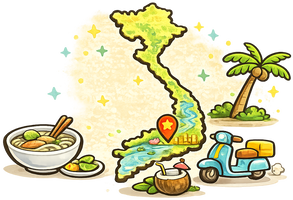
Southern Vietnamese (Sài Gòn dialect) is often associated with a softer sound in everyday speech. It’s the dialect you’ll hear across the Mekong Delta and in Ho Chi Minh City. If you plan to live in or interact often with the South, starting with the Southern dialect can be a practical choice.
On this pageQuick Facts
How it sounds
Southern Vietnamese sounds more relaxed in everyday speech. Some learners find the tones flow together. It can feel smooth to some and harder to distinguish for others.
How it's used
Everyday speech is informal and friendly. You’ll often hear regional slang and shortened words in markets, cafés, and casual conversations.
Where it's used
Common across Ho Chi Minh City and the South. If your friends, work, or travel are based here, the Southern dialect can be a practical first choice.
Northern comparison
Compared to Northern Vietnamese, you’ll notice differences in tone patterns and some vocabulary. Different dialect speakers usually understand each other well.
How to Learn Southern Vietnamese
Most Vietnamese learning resources default to a Northern accent. If you want to learn the Southern dialect, a few adjustments to your study plan make a big difference.
Use Southern audio
It is best to pick a one main course or teacher with a Southern accent. If you have a Northern-based book you like, you can still use it for grammar and vocabulary, but supplement with Southern audio. Consistent exposure to one dialect matters more than the specific resource.
Train the 5 spoken tones
In Southern speech, hỏi and ngã merge into one sound, so you are effectively working with five distinct tones in conversation. Use short repetition drills and listen to the same syllable with different tones to build a reliable ear. Keep in mind that all six tone marks are still used in writing, so spelling correctly still matters.
Practice with Southerners
Work with a Southern tutor or language partner so your pronunciation feedback matches your target dialect. If you'll spend time in Ho Chi Minh City or the South, even a few weekly conversations make your listening and speaking feel more natural.
Top Picks
Finding quality Southern Vietnamese resources can be tricky, since most courses default to Northern pronunciation. These are the ones our community like the most for learners focused on the Southern dialect.

1. Podglot
Podglot is a mobile app for learners who want quick, practical Vietnamese study on their phone. It is aimed at beginners, travelers, expats, and anyone who wants useful words and phrases rather than a heavy textbook approach. If you want short sessions focused on listening, speaking, and core vocabulary, this is the kind of app it is.
Pros
- Free to download
- Northern and Southern audio
- Built-in AI chat practice
- Good for short daily study
Cons
- No human teacher interaction
- Grammar depth looks limited
- Store listings conflict on content size

2. Lingora
Lingora is a mobile app for beginners who want a more structured Vietnamese course than a simple phrase app. The Vietnamese course is built around 500 short lessons that aim to take you from zero to about A1 level. A nice detail is that it offers both Northern and Southern Vietnamese, which is still uncommon in beginner apps.
Pros
- Northern and Southern audio
- Clear word-by-word explanations
- Structured beginner lesson path
- Free version available
Cons
- Mostly limited to A1
- No real conversation practice
- Less useful for advanced learners

3. Glossika
Glossika is a mobile app for learners who want to build Vietnamese through lots of listening and repetition rather than long grammar lessons. For Vietnamese, it offers separate Northern and Southern courses, so it is one of the few apps that lets you choose the dialect you want to hear. You can start from zero or take a placement test, which makes it usable for beginners as long as you are comfortable learning through patterns and repetition.
Pros
- Northern and Southern Vietnamese
- Strong native audio focus
- Good for daily repetition
- Offline study available
Cons
- Exercises can feel repetitive
- Limited explicit grammar teaching
- No live conversation practice
- Pricey subscription

4. VMonkey
VMonkey is a mobile app for preschool and primary-age children who are learning to read Vietnamese. It is built by Early Start as part of the Monkey learning ecosystem, and it is much more focused on literacy than on everyday conversation. If you want a child-friendly app with stories, read-aloud audio, and structured phonics practice, this is the kind of resource it is. If you are an adult learner, it will likely feel too young and too school oriented.
Pros
- Child-friendly reading practice
- Interactive stories and audiobooks
- Curriculum-based phonics lessons
- Northern and Southern accents
Cons
- Designed mainly for children
- Limited speaking practice
- Not suited to adult learners
- Full library needs subscription

5. DinoLingo
DinoLingo is a mobile app for kids learning Vietnamese, mainly aimed at ages 2 to 14. It is built for families more than adult self-learners, so the tone is playful and visual. If you want a child-friendly way to start from zero, it gives you a structured path with beginner lessons and lots of repetition.
Pros
- Strong for young children
- Structured beginner progression
- Six child profiles included
- Songs videos and books
Cons
- Limited grammar explanation
- No real conversation practice
- Can feel repetitive
- Built more for kids
Actually Understand Vietnamese is a YouTube-based resource for learners who want more understandable Vietnamese from day one. It is aimed at beginners through intermediate learners, and most of the library uses Southern Vietnamese, with a smaller set of Northern videos. If you learn best by listening to real speech instead of memorizing isolated phrases, this is the kind of channel to look at.
Pros
- Good graded listening content
- Mostly Southern accent
- Free videos on YouTube
- Helpful study tools on site
Cons
- Limited speaking practice
- Less Northern content
- Full library needs membership

Learn Southern Vietnamese with Thanh is a YouTube channel for learners who want to focus on Southern Vietnamese, especially pronunciation and everyday spoken language. It looks most useful for beginners and lower intermediate learners who want more exposure to a Southern accent instead of the Northern-focused materials that are easier to find.
Pros
- Free video lessons
- Southern accent focus
- Useful everyday language
- Good for shadowing practice
Cons
- No clear full curriculum
- Little built-in practice
- No direct speaking feedback
This is a small Easy Languages playlist of Vietnamese street interview videos hosted on YouTube. It is aimed at learners who already know some basic Vietnamese and want to hear how people speak in everyday situations, especially in Ho Chi Minh City.
Pros
- Free on YouTube
- Natural street interview audio
- Vietnamese and English subtitles
- Short videos for repeat listening
Cons
- Very small playlist
- No structured lessons
- No speaking practice
- Limited grammar support

Learn Vietnamese With Jane is a free YouTube channel for beginners who want to study Southern Vietnamese. It works best if you want a guided starting point without paying for a course. The channel is especially useful for self-study learners who need help with the basics before moving into conversations with native speakers.
Pros
- Free full beginner content
- Southern Vietnamese focus
- Clear pronunciation and tone lessons
- Includes listening practice
Cons
- No speaking feedback
- No built-in exercises
- Less useful for advanced learners

5. Langiri
Langiri’s YouTube channel is a listening-first Vietnamese resource for learners who want short, understandable videos instead of long lessons. It works especially well if you like learning through context, repetition, and everyday topics rather than heavy grammar teaching. Beginners can start with introductory and beginner videos, and there is enough range for lower intermediate learners too.
Pros
- Free listening practice
- Short graded videos
- Northern and Southern accents
- Good beginner topic range
Cons
- Not a full course
- No real speaking practice
- Limited explicit grammar teaching

1. Vietlingo
Vietlingo is a Vietnamese learning website built around one big choice that many apps ignore: dialect. You can study Southern, Northern, or Central Vietnamese, then book live lessons with a native teacher who speaks that variety. That makes it a practical pick for beginners, heritage learners, expats, and travelers who want the Vietnamese they will actually hear in real life.
Pros
- Teaches all three major dialects
- Free trial lesson offered
- 1-on-1 native teacher lessons
- AI pronunciation and conversation practice
Cons
- Paid tutoring is the core offer
- Limited independent user feedback
- Less focused on reading practice
Learn Vietnamese With Annie is a Southern Vietnamese school built for adults who want either structured self study or live lessons with a teacher. You can use the lesson library on their website and app, or book one to one classes online or in person. It works well for beginners, but the library also goes up through advanced levels.
Pros
- Strong Southern dialect focus
- Large lesson library
- 1-on-1 classes available
- Clear English breakdowns
Cons
- Not for Northern Vietnamese
- Less linear study path
- English support is central
3. Lingora
Lingora is a mobile app for beginners who want a more structured Vietnamese course than a simple phrase app. The Vietnamese course is built around 500 short lessons that aim to take you from zero to about A1 level. A nice detail is that it offers both Northern and Southern Vietnamese, which is still uncommon in beginner apps.
Pros
- Northern and Southern audio
- Clear word-by-word explanations
- Structured beginner lesson path
- Free version available
Cons
- Mostly limited to A1
- No real conversation practice
- Less useful for advanced learners
Learn Vietnamese Easy is a Southern Vietnamese learning website built around free study content and paid lessons. It suits beginners who want clear English explanations, then want to move into listening and speaking practice with a teacher. If you specifically want Southern pronunciation and everyday usage, it is more focused than broad all-dialect resources.
Pros
- Free lessons with audio
- Clear Southern Vietnamese focus
- Paid 1-on-1 tutoring available
- Beginner-friendly explanations
Cons
- Limited course catalog
- Mostly Southern dialect only
- Little advanced structured content

This is a free public-domain FSI course hosted by Live Lingua. It is a 247-page Vietnamese study manual aimed at beginners, especially learners who want a structured, old-school introduction to Southern Vietnamese and do not mind a drill-heavy approach.
Pros
- Free full PDF
- Structured lesson progression
- Strong pattern drills
- Includes glossary and phrases
Cons
- No audio for this title
- Dated teaching style
- Repetitive exercises
- Limited modern context
Vietnamese Vocabulary Core 1k is a free shared Anki deck for learners who want a ready-made beginner vocabulary list instead of building cards from scratch. It is based on the Vietnamese course in Ling and is available through AnkiWeb. If you are new to Vietnamese and want a simple daily review deck, this fits that job well.
Pros
- Free to use
- About 1,000 core words
- Example sentences included
- Northern and Southern audio
Cons
- Limited grammar support
- No real conversation practice
- Best used with other resources
This is a free shared Anki deck for learners who want Southern Vietnamese rather than the more commonly taught Northern standard. It fits best if you want Ho Chi Minh City style word choice and everyday expressions, or if you are learning to speak with Southern family and friends. Because it is an Anki deck, it works best as a daily review tool rather than a full course.
Pros
- Free shared deck
- Southern Vietnamese focus
- Good for daily review
- Useful for vocabulary building
Cons
- No full lesson structure
- Limited grammar support
- No conversation practice
This is a free Anki deck of very short Vietnamese sentences for beginners who want fast, repeatable practice. It fits best if you like learning through flashcards and short audio drills rather than long lessons or grammar explanations. You can get it on AnkiWeb, and LTL still lists it among its free shared decks on its Anki deck page.
Pros
- Free to download
- Short beginner friendly sentences
- English and Vietnamese audio
- Good for quick reviews
Cons
- No grammar explanations
- No real conversation practice
- Limited depth on its own
This is a free shared Anki deck for learners who want to study Vietnamese with a Southern focus. It is aimed at building everyday vocabulary and common phrases, so it makes the most sense if you want word choices that match speech in Ho Chi Minh City and other Southern contexts. If you already like flashcards and short daily review sessions, this is an easy resource to slot into your routine.
Pros
- Free Anki download
- Southern-focused word choice
- Good for daily review
Cons
- Not a full course
- No conversation practice
- Limited grammar support
This is a community-made Anki deck for beginners who want sentence-based Vietnamese practice instead of isolated word lists. It gives you more than 1,000 basic sentences and includes audio in both Northern and Southern accents, so it suits learners who want early exposure to dialect differences while building core vocabulary and reading comfort.
Pros
- Free to download
- 1,000+ sentence cards
- Northern and Southern audio
- Good for shadowing
Cons
- Not a full course
- Limited grammar explanation
- No conversation practice
- Older community-made deck
Not Sure What to Pick?
Take our quick quiz to find Vietnamese learning resources that match your level, dialect and study goals. It only takes a minute.
Pronunciation
Southern Vietnamese pronunciation differs from the North in three areas: tones, initial consonants, and syllable endings. These differences are consistent and predictable. Once you recognize them, listening becomes much easier.
Tones
Standard Vietnamese has six tones. In everyday Southern speech, the hỏi and ngã tones are pronounced the same way — typically as a falling-rising contour. This means Southern speakers effectively use five distinct tone patterns in conversation, even though all six tone marks are still used in writing.
The remaining four tones — ngang, huyền, sắc, and nặng — are similar to their Northern counterparts. Though Southern tones tend to rely more on pitch differences and less on voice quality changes like creaky or breathy phonation.
Hỏi – ngã merger
Words like mả and mã sound the same in Southern speech. Both use a mid falling-rising pitch. As a learner, listen for this pattern and continue writing the correct tone mark.
Nặng tone
In the North, nặng drops sharply with a glottal stop. In the South, it often sounds like a low dip that rises slightly, without the abrupt cut-off. This softer ending contributes to the perception that Southern speech flows more smoothly.
Initial consonants
Several consonant pairs that sound identical in Hanoi speech are kept distinct in the South. At the same time, Southern Vietnamese has its own mergers.
D and GI sound like Y
In the South, the letters d and gi are both pronounced like a y in English. In the North, they sound more like an English z. Either way, d and gi always sound the same as each other.
R keeps its sound
In the North, the letter r sounds like an English z. In the South, it keeps an r-like sound, closer to what you would expect from the spelling. The exact pronunciation varies between speakers, but it is always recognizably an r.
CH and TR, X and S sound alike
Many Southern speakers pronounce ch and tr the same, and x and s the same. This merger is growing among younger urban speakers. It's good to know the spelling difference even if you don't hear it.
Syllable endings
In Southern speech, final consonants can shift depending on the preceding vowel. After short front vowels (like those in anh, inh, ênh), the endings -nh and -ch are pronounced as -n and -t. After rounded vowels (like those in ung, ông, ong), final -ng and -c can sound like -ngm and -kp with a lip closure.
For learners, this mainly affects listening comprehension. Always base your spelling on standard written Vietnamese. Over time, your ear adjusts to these shifts naturally.
Words & Phrases
Southern Vietnamese shares most vocabulary with the rest of the country, but some everyday words differ. These are not slang or mistakes — they are standard usage in the South. Here are some common ones you will hear often.
| English | Southern | Northern | Notes |
|---|---|---|---|
| yes | dạ | vâng | There are multiple ways to say yes, this is a common formal way to say yes |
| bowl | chén | bát | |
| father | ba | bố | |
| mother | má | mẹ | |
| fruit | trái | quả | Used as the word and classifier for fruit |
| cup or glass | ly | cốc | |
| flower | bông | hoa | |
| pig | heo | lợn | |
| traffic jam | kẹt xe | tắc đường | |
| hat | nón | mũ |
Pronouns
Southern speakers often use tui instead of tôi for I in casual settings. Tụi is commonly used as a group marker, as in tụi mình for us and tụi nó for them. You'll also hear contracted forms like ổng for ông ấy and bả for bà ấy.
Sentence particles
Southern Vietnamese uses nha and nghen at the end of sentences to soften requests or confirm agreement. For example, ăn cơm nha is a gentle way of saying let's eat. In the North, you would more commonly hear nhé or nhỉ in similar situations.
FAQ
Looking for Resources?
Explore our hand-picked learning resources in the library. Browse the full library with filters for dialect, skills and more, to find the best resources for your learning goals.