
Hello in Vietnamese: Xin Chào, Chào, and Real Greetings
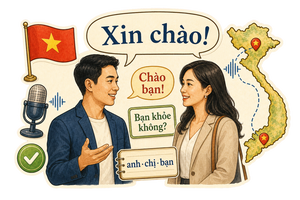
Vietnamese has no single word for "hello" that fits every situation. Xin chào works everywhere and never sounds rude, but locals rarely use it with each other. The greetings that locals actually use are short, warm, and depend on who you are talking to.
| Situation | Say |
|---|---|
| Safe with anyone | Xin chào |
| Older man | Chào anh |
| Older woman | Chào chị |
| Younger person | Chào em |
| Everyone in a group | Chào mọi người |
Xin Chào: The Universal Hello
Xin chào is the most widely recognized Vietnamese greeting. It works in any situation, with anyone, and is always polite. If you only learn one greeting, make it this one.
Meaning
Xin means "to request" or "please". Chào means "to greet". Together, xin chào literally means "I respectfully greet you". It carries a polite, slightly formal tone.
When to use it
Use xin chào when meeting someone for the first time, in formal settings, or when you are unsure which pronoun to use. It is always safe and never sounds rude. Textbooks teach it as the default greeting, and every Vietnamese speaker understands it.

Preply
A website for finding and booking live 1-on-1 Vietnamese tutors by price, availability, specialty, and accent, with paid trial lessons.
How Vietnamese People Actually Say Hello
The most natural way to greet someone in Vietnamese is chào followed by the right pronoun for the person you are talking to. This pattern is what you will hear on the street, in shops, and between friends and family.
Vietnamese does not have a single word for "you". Instead, speakers choose a pronoun based on the other person's age and gender relative to their own. The pronoun you pick shows respect and sets the tone of the conversation.
| Greeting | Who you are talking to | You call yourself |
|---|---|---|
| Chào anh | A man slightly older than you | em |
| Chào chị | A woman slightly older than you | em |
| Chào em | Someone younger than you | anh or chị |
| Chào ông | An older man, grandfather's age | cháu or con |
| Chào bà | An older woman, grandmother's age | cháu or con |
| Chào cô | A woman your parent's age | cháu or con |
| Chào chú | A man your parent's age | cháu or con |
| Chào bạn | A friend or peer your age | tôi or mình |
A typical exchange looks like this:
You: Chào chị! — Hello! (to an older woman)
Her: Chào em! — Hello! (to someone younger)
Notice how both speakers use chào, but each picks a different pronoun. The older woman says chào em because you are younger. You say chào chị because she is older. This is the heart of Vietnamese greetings.
Choosing the Right Pronoun
Picking the right pronoun can feel overwhelming at first. The good news is that you only need a handful of pronouns to cover most everyday situations. The main factor is age: is the other person older, younger, or about the same age as you?
Slightly older
Anh for a man, chị for a woman.
These are the most common pronouns. Use them for anyone who looks a few years older than you up to middle age. They come from the words for "older brother" and "older sister".
Younger
Em for anyone younger, regardless of gender.
It means "younger sibling". This is also the pronoun couples use for the younger partner or when speaking affectionately.
Much older
Ông for a man, bà for a woman.
These mean "grandfather" and "grandmother". Use them for elderly people or in very formal situations. The speaker refers to themselves as cháu or con.
Casual and Informal Greetings
Among friends and people you know well, Vietnamese speakers often skip chào entirely. Instead, they use one of several casual conversation starters that function like "hey" or "what's up" in English.
| Vietnamese | Meaning | When to use |
|---|---|---|
| Ê | Hey! | Very casual, between close friends |
| Đi đâu đấy? | Where are you going? | Common greeting when passing someone on the street |
| Ăn cơm chưa? | Have you eaten yet? | A warm, traditional greeting showing care |
| Lâu quá không gặp! | Long time no see! | Reconnecting with someone after a while |
| Khỏe không? | Are you well? | Friendly check-in, similar to "how are you?" |
"Where are you going?"
Đi đâu đấy? is not a real question about your destination. It is just a way of saying "hi" when you see someone out and about. A typical response is a casual, vague answer like đi chơi meaning "going out" or đi chợ meaning "going to the market". You do not need to give an honest, detailed answer.
"Have you eaten yet?"
Ăn cơm chưa? literally asks if you have eaten rice. It is a traditional way to show care, rooted in Vietnamese culture where sharing meals is central to relationships. You can answer rồi meaning "already" or chưa meaning "not yet". This greeting is especially common among older generations.
Greetings by Time of Day
Vietnamese has equivalents for "good morning", "good afternoon", and "good evening". These are formed by combining chào buổi with a time-of-day word. However, they are much less common than in English and sound slightly formal in daily conversation.
| Vietnamese | English | Approximate time |
|---|---|---|
| Chào buổi sáng | Good morning | sunrise to about 11 AM |
| Chào buổi chiều | Good afternoon | about 1 PM to 6 PM |
| Chào buổi tối | Good evening | about 6 PM onward |
How to Say "How Are You?"
After saying hello, you may want to ask how someone is doing. Vietnamese has several ways to express this, depending on how formal or casual the conversation is.
| Vietnamese | Meaning | Tone |
|---|---|---|
| Bạn khỏe không? | Are you healthy? | Standard, polite |
| Anh/Chị khỏe không? | Are you well? | Respectful, uses pronoun |
| Khỏe không? | Well? | Casual, between friends |
| Dạo này thế nào? | How have things been lately? | Friendly, conversational |
The word khỏe means "healthy" or "well". Just like in English, bạn khỏe không? is often more of a social nicety than a genuine question about health. Replace bạn with the appropriate pronoun for the person you are speaking to. For example, chị khỏe không? when talking to an older woman.
Example conversation
A: Chào chị! Chị khỏe không? — Hello! How are you?
B: Chào em! Chị khỏe, cảm ơn em. Em thì sao? — Hello! I'm well, thank you. How about you?
A: Em cũng khỏe ạ. — I'm well too.
The reply above uses cảm ơn. See the thank you in Vietnamese guide for polite and casual ways to use it.
How to Respond to a Greeting
When someone greets you in Vietnamese, the simplest response is to greet them back using the same pattern. Mirror the chào and use the correct pronoun for them.
| They say | You respond | Why |
|---|---|---|
| Chào em! | Chào anh! or Chào chị! | They are older, so use anh or chị |
| Chào anh! | Chào em! | They are younger, so use em |
| Chào ông! | Chào cháu! or Chào con! | They are much younger than you |
| Xin chào! | Xin chào! | Matching the formal style |
When the conversation ends, the goodbye in Vietnamese guide explains the natural alternatives to tạm biệt.
Northern vs. Southern Differences
The core greetings are the same across Vietnam, but pronunciation and some word choices differ between the North and the South.
| Feature | Northern | Southern |
|---|---|---|
| Tones | Six distinct tones | Five tones (hỏi and ngã merge) |
| Pronunciation of "chào" | Starts with a "ch" sound | Same "ch" sound |
| "Where are you going?" | Đi đâu đấy? | Đi đâu vậy? |
| Calling yourself to elders | Tends to use cháu | Tends to use con |
| Between friends | Cậu and tớ | Bạn and tôi or mình |
All greetings in this guide work in both regions. The differences are mainly in pronunciation and a few word preferences. For a deeper look at each dialect, see our Northern Vietnamese guide and Southern Vietnamese guide.
Greetings in Common Situations
Here are some typical scenarios to help you choose the right greeting.
Meeting your partner's parents
You: Con chào bác ạ! — Hello, uncle/aunt!
Use bác for someone your parent's age or older. Adding ạ shows extra respect. This is important in Vietnamese culture, especially when meeting family for the first time.
Entering a shop or restaurant
You: Chào chị! — Hello! (to a female shopkeeper)
Use anh for a male worker, chị for a female. A greeting when entering shows friendliness and is appreciated, though not always required.
Joining a group of friends
You: Chào mọi người! — Hello everyone!
Mọi người means "everyone". This is a convenient way to greet a group without choosing individual pronouns.
Answering the phone
You: A-lô? — Hello?
Vietnamese borrowed a-lô from the French allô. It is used exclusively for answering phone calls, never in person.
If you need to get someone's attention or apologize during one of these exchanges, see how to say sorry in Vietnamese without sounding abrupt.
Quick Reference Table
A cheat sheet with the most useful Vietnamese greetings. Bookmark this page and come back whenever you need a refresher.
| English | Vietnamese |
|---|---|
| Formal greetings | |
| Hello (universal) | Xin chào |
| Hello (to older man) | Chào anh |
| Hello (to older woman) | Chào chị |
| Hello (to younger person) | Chào em |
| Hello (to elderly man) | Chào ông |
| Hello (to elderly woman) | Chào bà |
| Hello everyone | Chào mọi người |
| Time of day | |
| Good morning | Chào buổi sáng |
| Good afternoon | Chào buổi chiều |
| Good evening | Chào buổi tối |
| Casual greetings | |
| Hey! | Ê! |
| Where are you going? | Đi đâu đấy? |
| Have you eaten yet? | Ăn cơm chưa? |
| Long time no see! | Lâu quá không gặp! |
| How are you? | |
| How are you? (polite) | Bạn khỏe không? |
| How are you? (casual) | Khỏe không? |
| I'm fine, thank you | Tôi khỏe, cảm ơn |
| And you? | Còn bạn? |
| Other useful phrases | |
| Hello? (phone) | A-lô? |
| Nice to meet you | Rất vui được gặp bạn |
| What is your name? | Bạn tên gì? |
| My name is... | Tôi tên là... |
FAQ
Looking for Resources?
Explore our hand-picked learning resources. Filter by dialect, skills and more to find the best resources for your learning goals.