
Best Podcasts to Learn Vietnamese (2026)

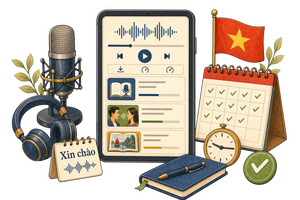
Illustration of Vietnamese learning podcasts

Podcasts let you hear real Vietnamese at any level, from slow beginner lessons to fast native conversations. They train your ear for tone, rhythm, and connected speech in ways that textbooks and flash cards cannot. Best of all, you can listen while commuting, cooking, or walking, which makes it easy to add listening time without changing your schedule.

This page helps you choose the right podcast type for your level, explains how to get the most out of each listening session, and covers the mistakes that keep learners stuck.

On this page

Top Picks

1. VietnamesePod101

VietnamesePod101 is an audio and video lesson library for learning Vietnamese from beginner to advanced. It works well if you like learning by listening, want lots of short lessons, and prefer a guided “pick a pathway and press play” style.

Lessons come with read-along transcripts and lesson notes, plus tools like vocabulary lists, a personal word bank, and spaced repetition flashcards. Premium tiers add features like line-by-line audio and assessments, which can make listening practice more structured. You can browse lessons and study on the VietnamesePod101 website or use their Innovative Language 101 app.

Pros

  • Huge audio and video catalog
  • Transcripts and detailed lesson notes
  • Spaced repetition flashcards included
  • Optional 1-on-1 teacher feedback

Cons

  • Speaking practice limited on lower plans
  • Can feel overwhelming without a plan
  • Premium PLUS costs more

2. Go Vietnamese

Go Vietnamese is a tutoring service based in Da Nang and Hoi An, with options for 1-on-1, small groups, and online lessons. It suits beginners who want a practical speaking foundation, and travelers or expats who want everyday Vietnamese they can use right away.

Lessons focus heavily on pronunciation and “speak like a local” everyday language. You can meet at their classroom, at your place, or even a quiet coffee shop, and they also teach online via video calls. If you already have an accent preference, they let you choose a teacher who can work with Northern, Da Nang (Central), or Southern pronunciation. Details are on their website and the class formats are outlined on the Lessons page.

Pros

  • In person tutoring in Da Nang
  • Strong pronunciation focus
  • Podcast with free transcripts

Cons

  • Pricing not clearly centralized
  • Limited structured self-study drills

3. Vietnamese News (NHK World Japan)

Vietnamese News from NHK WORLD-JAPAN is a short, Vietnamese-language news podcast based on NHK WORLD RADIO JAPAN broadcasts. It’s best for intermediate and advanced learners who want real listening practice and a quick way to keep up with Japan and world news in Vietnamese.

Episodes are around 9 to 10 minutes and are designed like a radio news bulletin. You can listen in a podcast app such as Apple Podcasts or through the show’s RSS feed, which makes it easy to add to most podcast players.

Pros

  • Short 10-minute episodes
  • Real-world news vocabulary
  • Free in podcast apps

Cons

  • No built-in transcripts
  • Not a structured course
  • Fast pace for beginners

4. Levion

Levion is an online Vietnamese learning platform built around a subscription library of self-study courses. It’s a good fit if you want structured lessons you can do on your own, and you like having the option to add live classes later.

With a subscription, you get access to multiple courses across listening, grammar, and pronunciation, broken into short lesson-based curricula. There’s also a free level test to help you pick a starting point, and the course catalog makes it easy to see what’s included.

Pros

  • Clear monthly and yearly pricing
  • Free Vietnamese level test
  • Structured A1 and A2 Zoom classes
  • Pronunciation includes North vs South

Cons

  • Dialect not labeled per course
  • Limited independent reviews

5. Vietcetera

Vietcetera is a Vietnam-focused digital media brand with both a Vietnamese edition and an English “International Edition”. It’s best for intermediate to advanced learners who want real-world reading and listening practice, not step-by-step lessons.

You can read current articles across topics like business, culture, travel, lifestyle, and more on their website. Because it’s written for native or fluent readers, it’s a solid way to pick up modern wording, headlines, and how people talk about today’s Vietnam, but you will run into slang, names, and dense references quickly.

Pros

  • Real Vietnamese from current topics
  • Vietnamese and English editions
  • Lots of podcast-style listening

Cons

  • Not structured for learners
  • Vocabulary can be very advanced
  • No built-in exercises or quizzes
View more Top Podcasts in the library.

1. Learn Vietnamese Easy

Learn Vietnamese Easy is an online learning platform focused on practical Southern Vietnamese. It works best if you want clear pronunciation guidance and a mix of self-study and live speaking practice with a tutor.

For free, you can work through the blog with English-supported explanations, example sentences, and audio on many posts. There’s also a page of quizzes and games you can use for quick review.

Pros

  • Strong Southern pronunciation focus
  • Free lessons with audio
  • 1-on-1 Skype tutoring available
  • Quizzes and games for review

Cons

  • Not aimed at Northern accent
  • Limited advanced structured curriculum
  • Podcast catalog is small

2. Learn Vietnamese With Annie

Learn Vietnamese With Annie is a Southern Vietnamese learning platform built around short, natural dialogues. It suits beginners through advanced learners who want more real spoken Vietnamese than textbook-style sentences.

The core product is a subscription library on the website and mobile app, with dialogues usually under a minute, followed by Vietnamese and English discussion, vocabulary review audio, bilingual transcripts, and online exercises. Lessons are grouped by level, and new lessons are added regularly.

Pros

  • Southern dialect, everyday conversations
  • Bilingual transcripts and breakdowns
  • Exercises plus vocab review audio
  • Online and in-person tutoring

Cons

  • Not a strict lesson sequence
  • Listening-first, limited speaking feedback
  • Southern-focused, not for all goals

3. Vitamese

Vitamese is a Southern Vietnamese learning hub built around listening practice. If you want more exposure to natural speech and a Saigon-style accent, it’s a good fit, especially as a supplement to a main course or textbook.

The core content is the podcast. VTM1 is a free, monthly show with short, unscripted monologues by a native speaker who talks a bit slower and clearer than normal. VTM2 is a paid weekly feed and can include guest conversations, so you get more frequent practice and a wider range of voices.

Pros

  • Unscripted, natural Southern speech
  • Free podcast option available
  • Weekly paid feed for consistency
  • Extra pronunciation videos and articles

Cons

  • Not a structured curriculum
  • Limited interactive practice
  • Beginner level may still feel fast

4. HowToVietnamese

HowToVietnamese is an online self-study hub for learners who want a Southern (Saigon-style) accent, especially if you are starting from zero and want a clear path into pronunciation and basic sentence building.

On the free side, you get structured mini-courses like the pronunciation guide that walks through the alphabet, vowels, consonants, and tones, including a lesson on Southern vs Northern tones. There are also short beginner courses for basics, phrases, and numbers listed on the Learning page.

Pros

  • Clear Southern pronunciation walkthrough
  • Free beginner mini-courses
  • Audio plus transcripts for listening
  • Downloadable eBooks with examples

Cons

  • No live speaking feedback
  • Limited higher-level progression
  • Mostly self-study format

5. Learn Vietnamese with SVFF (SVFF)

Learn Vietnamese with SVFF is a Southern-dialect focused program for learners who want practical, conversational Vietnamese with a Saigon-style accent. It works well for beginners who want a clear path and a real teacher, not just an app.

The core offering is paid 1-on-1 tutoring you book through their website, including a free trial lesson. Lessons follow a level-based curriculum (starting at Level 0 for pronunciation), and they also offer in-person classes in Ho Chi Minh City if you want face-to-face practice.

Pros

  • Strong Southern pronunciation focus
  • Free trial and free samples
  • PDFs plus quizzes in podcasts
  • Optional AI lesson summaries

Cons

  • Most content requires payment
  • Southern-focused, not universal
  • Podcast listening is stream-only
  • Heavy English support in lessons
View more Southern Podcasts in the library.

1. Go Vietnamese

Go Vietnamese is a tutoring service based in Da Nang and Hoi An, with options for 1-on-1, small groups, and online lessons. It suits beginners who want a practical speaking foundation, and travelers or expats who want everyday Vietnamese they can use right away.

Lessons focus heavily on pronunciation and “speak like a local” everyday language. You can meet at their classroom, at your place, or even a quiet coffee shop, and they also teach online via video calls. If you already have an accent preference, they let you choose a teacher who can work with Northern, Da Nang (Central), or Southern pronunciation. Details are on their website and the class formats are outlined on the Lessons page.

Pros

  • In person tutoring in Da Nang
  • Strong pronunciation focus
  • Podcast with free transcripts

Cons

  • Pricing not clearly centralized
  • Limited structured self-study drills

2. Levion

Levion is an online Vietnamese learning platform built around a subscription library of self-study courses. It’s a good fit if you want structured lessons you can do on your own, and you like having the option to add live classes later.

With a subscription, you get access to multiple courses across listening, grammar, and pronunciation, broken into short lesson-based curricula. There’s also a free level test to help you pick a starting point, and the course catalog makes it easy to see what’s included.

Pros

  • Clear monthly and yearly pricing
  • Free Vietnamese level test
  • Structured A1 and A2 Zoom classes
  • Pronunciation includes North vs South

Cons

  • Dialect not labeled per course
  • Limited independent reviews
View more Northern Podcasts in the library.

Choosing a Podcast

There are many Vietnamese podcasts out there, but not all of them are useful for learning. The right podcast matches your current level and gives your brain something to hold onto. If you cannot follow at least half of what is being said, the podcast is too hard to learn from right now. These four qualities matter most.

Match your level

A podcast that is too easy does not push you forward, and one that is too hard becomes background noise. Aim for content where you understand roughly 60 to 80 percent. That is where your brain works hardest to fill in the gaps, which is what drives real listening improvement.

Transcripts available

A transcript turns passive listening into active study. You can read along to catch words you missed, look up unfamiliar vocabulary after, and confirm what you heard. Podcasts without transcripts are fine for review, but transcripts make a big difference when you are learning new material.

Consistent dialect

Vietnamese podcasts may use Northern, Southern, or Central pronunciation without saying so explicitly. Pick a podcast that matches the dialect you are learning and stick with it, especially early on. Mixing dialects across different shows confuses your ear before it has had time to settle into one sound system.

Not sure which dialect to focus on? Read the Northern and Southern Vietnamese guides.

Clear audio quality

Vietnamese tones rely on small pitch differences that are easy to miss in low-quality recordings. Podcasts with clean, well-recorded audio help you hear tones and vowels accurately. Avoid shows with heavy background music, echo, or inconsistent volume, especially while your ear is still adjusting.

Podcast Types

Not all podcasts serve the same purpose. Each type trains a different skill, and combining two or three across your week is more effective than relying on one format alone.

Type Best for What to expect
Lesson podcast Beginners building vocabulary and grammar Structured episodes with explanations in English and Vietnamese, slow pacing, repetition of key phrases
Story podcast Following narratives at a comfortable level Short stories or anecdotes in clear Vietnamese, natural repetition through plot, often with transcripts
Slow talk podcast Intermediate learners building comprehension depth A single host speaking clearly about culture, daily life, or current topics at a measured pace
Conversation podcast Training your ear for real spoken Vietnamese Two or more speakers at natural speed with interruptions, slang, and informal phrasing
Native content Advanced listeners staying immersed Podcasts made for Vietnamese speakers on any topic: news, tech, business, entertainment

How to Listen

Pressing play is only half the work. How you listen determines whether a podcast builds your skills or just fills silence. These habits turn listening time into real practice.

Listen more than once

The first listen is for gist: what is the episode about? The second listen is for detail: what words and patterns can you pick out? Re-listening to the same episode does more for your ear than jumping to a new one every time. Repetition is how your brain moves sounds from noise to meaning.

Save new words from episodes into flash cards so you remember them long-term.

Use the transcript actively

If the podcast has a transcript, listen first without reading. Then read the transcript to fill in what you missed. Finally, listen again with the words fresh in your mind. This three-step loop, listen then read then listen, builds both ear and vocabulary at the same time.

Shadow short sections

Pick a sentence or two and repeat them out loud right after the speaker. This is called shadowing, and it trains your mouth to produce the same rhythm, tones, and vowels you are hearing. You do not need to shadow an entire episode. Even a few minutes per session makes a noticeable difference over weeks.

Common Mistakes

Podcasts are one of the best tools for Vietnamese listening, but a few habits can quietly waste your time if you are not careful.

Passive background listening

Leaving a podcast on while you do something else feels productive but teaches very little. Your brain needs to actively work at understanding for listening to improve. If you cannot pay attention, it is better to listen to a shorter episode with full focus than a long one as background noise.

Starting too hard

Jumping straight into native-speed podcasts as a beginner is frustrating and ineffective. If you understand less than half of what you hear, the podcast is not teaching you yet. Start with lesson or story podcasts and work your way up as your comprehension grows.

Never re-listening

Always moving to the next episode means you never fully absorb the current one. The gains come from hearing the same material again after your brain has had time to process it. Re-listen to episodes where you understood most but not all of the content, that is where learning happens fastest.

Only listening, never speaking

Listening builds recognition, but it does not automatically build speaking ability. If you never repeat what you hear, you train a passive skill only. Add short shadowing sessions or pair your podcast habit with a conversation tutor to close the gap between what you understand and what you can say.

FAQ

Podcasts are great for building listening skills, getting used to natural pronunciation, and picking up vocabulary in context. However, listening alone will not teach you to speak, read, or write. Combine podcasts with active practice such as shadowing, flash cards, or conversation sessions to turn passive input into usable Vietnamese.

Look for a podcast that uses slow, clear speech with some English explanations or translations. Lesson-style podcasts designed for learners are the easiest entry point. Avoid native-speed conversation shows until you can follow at least half of what a slower podcast says.

It varies by show. Some podcasts use Northern pronunciation, others Southern, and a few mix both. Check the first episode or show description to confirm the dialect before committing. Consistency matters most in the early stages when your ear is still adjusting to one sound system.

Fifteen to thirty minutes of focused listening is more effective than hours of background audio. If you can pay full attention, even a single short episode per day adds up quickly. Quality of attention matters more than total time.

Both. Listen first without the transcript to train your ear. Then read the transcript to catch what you missed. Finally, listen again with the new words fresh in your mind. This listen-read-listen loop is one of the most effective ways to improve comprehension.

Shadowing means repeating what the speaker says right after you hear it, matching their rhythm and tones as closely as possible. It is one of the best ways to improve pronunciation and fluency because it connects listening directly to speaking. Even a few minutes of shadowing per session makes a noticeable difference over weeks.

Start mixing in native-speed content once you can follow most of a slow or intermediate podcast without pausing. You do not need to understand everything. If you can follow the general topic and catch key words, your ear is ready for more challenge. Keep a learner podcast in your rotation for review while gradually adding native shows.

Re-listening is one of the most effective study habits. The first listen gives you the gist, and each replay lets you catch more detail, new words, and natural phrasing you missed before. Repetition builds real comprehension faster than constantly skipping to new episodes.
Explore More

Want to Discover More?

Explore our hand-picked learning resources in the library. Browse the full library with filters for dialect, skills and more, to find the best resources for your learning goals.

Want to stay in the loop?

Subscribe to our newsletter for the latest resources. We promise we won't spam you, you will receive one email a month at most.