
How to Learn Southern Vietnamese

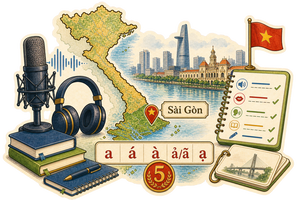
Illustration of South Vietnam

Southern Vietnamese (Sài Gòn dialect) is often associated with a softer sound in everyday speech. It’s the dialect you’ll hear across the Mekong Delta and in Ho Chi Minh City. If you plan to live in or interact often with the South, starting with the Southern dialect can make real-world conversations feel more natural.

On this page

Quick Facts

How it sounds

Southern Vietnamese sounds more relaxed in everyday speech. Some learners find the tones flow together. It can feel smooth to some and harder to distinguish for others.

How it's used

Everyday speech is informal and friendly. You’ll often hear regional slang and shortened words in markets, cafés, and casual conversations.

Where it's used

Common across Ho Chi Minh City and the South. If your friends, work, or travel are based here, the Southern dialect can be a practical first choice.

Northern comparison

Compared to Northern Vietnamese, you’ll notice differences in tone patterns and some vocabulary. Different dialect speakers usually understand each other well.

How to Learn Southern Vietnamese

Most Vietnamese learning resources default to a Northern accent. If you want to learn the Southern dialect, a few adjustments to your study plan make a big difference.

Match your audio

Pick a main course or textbook that uses Southern pronunciation. If your book is Northern-based, supplement with Southern audio from podcasts, YouTube channels, or apps that let you choose a dialect. Consistent exposure to one dialect matters more than the specific resource.

Write all six tones

Even though hỏi and ngã sound the same in the South, you must write them correctly. Read carefully and use dictation exercises to build correct spelling habits. This skill pays off when texting, emailing, or reading formal Vietnamese.

Practice with Southerners

Find a tutor, language partner, or community that speaks the Southern dialect. Vietnamese American communities in the US predominantly use Southern pronunciation, which makes them a natural resource for practice and immersion.

Pronunciation

Southern Vietnamese pronunciation differs from the North in three areas: tones, initial consonants, and syllable endings. These differences are consistent and predictable. Once you recognize them, listening becomes much easier.

Practice every syllable and tone combination with the interactive chart on VietSyllables.

Tones

Standard Vietnamese has six tones. In everyday Southern speech, the hỏi and ngã tones are pronounced the same way — typically as a falling-rising contour. This means Southern speakers effectively use five distinct tone patterns in conversation, even though all six tone marks are still used in writing.

The remaining four tones — ngang, huyền, sắc, and nặng — are similar to their Northern counterparts. Though Southern tones tend to rely more on pitch differences and less on voice quality changes like creaky or breathy phonation.

Hỏi – ngã merger

Words like mả and sound the same in Southern speech. Both use a mid falling-rising pitch. As a learner, listen for this pattern and continue writing the correct tone mark.

Nặng tone

In the North, nặng drops sharply with a glottal stop. In the South, it often sounds like a low dip that rises slightly, without the abrupt cut-off. This softer ending contributes to the perception that Southern speech flows more smoothly.

Initial consonants

Several consonant pairs that sound identical in Hanoi speech are kept distinct in the South. At the same time, Southern Vietnamese has its own mergers.

D and GI sound like Y

In the South, the letters d and gi are both pronounced like a y in English. In the North, they sound more like an English z. Either way, d and gi always sound the same as each other.

R keeps its sound

In the North, the letter r sounds like an English z. In the South, it keeps an r-like sound, closer to what you would expect from the spelling. The exact pronunciation varies between speakers, but it is always recognizably an r.

CH and TR, X and S sound alike

Many Southern speakers pronounce ch and tr the same, and x and s the same. This merger is growing among younger urban speakers. It's good to know the spelling difference even if you don't hear it.

Syllable endings

In Southern speech, final consonants can shift depending on the preceding vowel. After short front vowels (like those in anh, inh, ênh), the endings -nh and -ch are pronounced as -n and -t. After rounded vowels (like those in ung, ông, ong), final -ng and -c can sound like -ngm and -kp with a lip closure.

For learners, this mainly affects listening comprehension. Always base your spelling on standard written Vietnamese. Over time, your ear adjusts to these shifts naturally.

Words & Phrases

Southern Vietnamese shares most vocabulary with the rest of the country, but some everyday words differ. These are not slang or mistakes — they are standard usage in the South. Here are some common ones you will hear often.

English Southern Northern Notes
yes (polite) dạ vâng Used across the South in formal and semi-formal speech
rice bowl chén bát One of the most well-known North–South vocabulary differences
spoon muỗng thìa
cup / glass ly cốc From the French word lit (reading glass), adopted during the colonial period
this này
that đó đấy
car xe hơi ô tô Both forms are widely understood
ladle muôi
Explore flash cards and Anki decks to learn Southern Vietnamese words & phrases.

Pronouns

Southern speakers often use tui instead of tôi for I in casual settings. Tụi is commonly used as a group marker, as in tụi mình for us and tụi nó for them. You'll also hear contracted forms like ổng for ông ấy and bả for bà ấy.

Sentence particles

Southern Vietnamese uses nha and nghen at the end of sentences to soften requests or confirm agreement. For example, ăn cơm nha is a gentle way of saying let's eat. In the North, you would more commonly hear nhé or nhỉ in similar situations.

FAQ

Choose Southern Vietnamese, often called the Saigon dialect, if you plan to live in Ho Chi Minh City or the Mekong Delta, or if the people you'll speak with most use Southern pronunciation. If your goal is overseas family or community, Southern is often a practical default. Dialect choice will not break your Vietnamese. Both Northern and Southern are complete and widely usable.

Many descriptions treat Southern Vietnamese as a five-tone system because the hỏi and ngã tones are commonly pronounced the same in Southern accents. Writing still marks hỏi and ngã differently, so you still need to use the standard tone marks when you write. A good approach is to learn Southern tone patterns for listening and speaking, and build correct spelling through reading and short dictation exercises.

In Ho Chi Minh City Vietnamese, some final sounds can blend together in casual speech, depending on the vowel. In particular, endings written as t and c, and endings written as n and ng, can sound more similar after certain short vowels. For learners, this mainly affects listening. Keep your spelling based on standard written Vietnamese, and expect real-world pronunciation to simplify some word endings.

Usually, yes. Vietnamese is commonly described as having three mutually intelligible regional dialects in the North, Central, and South. The biggest differences are pronunciation and some everyday vocabulary. Central varieties can be harder to understand at first, but North and South communication is typically smooth, and it improves quickly with exposure.

The main differences are pronunciation, some everyday vocabulary, and sentence particles. Tones: the South merges hỏi and ngã into one tone, while the North keeps them separate. Consonants: the Southern accent pronounces d and gi as a y sound, while Hanoi pronounces them as z. The letter r keeps an r-like sound in the South but becomes z in Hanoi. Vocabulary: common words like 'yes' (dạ vs vâng), 'rice bowl' (chén vs bát), and 'spoon' (muỗng vs thìa) differ by region. Written Vietnamese is the same nationwide.

Neither dialect is objectively easier, but some learners feel the Southern tone system is simpler because it merges hỏi and ngã into one sound pattern — effectively five tones instead of six. On the other hand, Southern syllable ending mergers can make listening harder at first. The best choice depends on who you'll speak with and which audio resources match your needs, not on difficulty.

Yes. Written Vietnamese is largely the same across dialects. A Northern textbook will teach you correct grammar, vocabulary, and spelling. To learn Southern pronunciation, pair it with Southern audio: podcasts, YouTube channels, or a tutor who speaks with a Saigon accent. Focus on recognizing the tone and consonant differences. Many learners successfully use Northern textbooks with Southern pronunciation practice.
Explore More

Want to Discover More?

Explore our hand-picked study resources in the library. Browse the full library with filters for dialect, learning-goal and more, to find the best resources for your study goals.

Want to stay in the loop?

Subscribe to our newsletter for the latest resources. We promise we won't spam you, you will receive one email a month at most.