
Vietnamese Alphabet: All 29 Letters, Tones, and Pronunciation
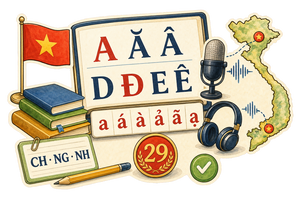
The Vietnamese alphabet uses Latin letters, just like English, but with a few twists. There are 29 letters instead of 26, and many letters carry extra accents or tone marks. This guide walks you through every letter, vowel, consonant, and tone mark in the Vietnamese alphabet.
The 29 Letters
The Vietnamese alphabet is called chữ Quốc ngữ, meaning "script of the national language". It was developed by Portuguese and Italian missionaries in the 1600s to write Vietnamese using Latin letters. Today it is the only writing system used in Vietnam.
Vietnamese takes 22 letters from the standard Latin alphabet and adds 7 more with diacritics: ă, â, đ, ê, ô, ơ, and ư. The four letters f, j, w, and z are not part of the Vietnamese alphabet, though they sometimes appear in loanwords and foreign names.
| Letter | A | Ă | Â | B | C | D | Đ | E | Ê | G | H | I | K | L | M | N | O | Ô | Ơ | P | Q | R | S | T | U | Ư | V | X | Y |
|---|---|---|---|---|---|---|---|---|---|---|---|---|---|---|---|---|---|---|---|---|---|---|---|---|---|---|---|---|---|
| Lower | a | ă | â | b | c | d | đ | e | ê | g | h | i | k | l | m | n | o | ô | ơ | p | q | r | s | t | u | ư | v | x | y |
Of these 29 letters, 12 are vowels and 17 are consonants. The alphabet also has 10 two-letter combinations called digraphs and one three-letter combination called a trigraph. These represent sounds that a single letter cannot capture on its own.

Preply
A website for finding and booking live 1-on-1 Vietnamese tutors by price, availability, specialty, and accent, with paid trial lessons.
The 12 Vowels
Vietnamese has 12 vowel letters. Six of them look like standard Latin vowels, and six have diacritics that change the sound. Getting the vowels right is essential because Vietnamese words are often distinguished only by their vowel sounds. Unlike consonants, vowels sound largely the same across Northern and Southern Vietnamese, so the descriptions below apply to all speakers.
| Letter | Sound | Example | Meaning |
|---|---|---|---|
| a | "ah" as in "father" | ba | three |
| ă | "ah" as in "father" but shorter | ăn | to eat |
| â | "uh" as in "hut" but shorter | ân | grace |
| e | "eh" as in "bet" | em | younger sibling |
| ê | "ay" as in "say" without the glide | bê | calf |
| i | "ee" as in "see" | đi | to go |
| o | "aw" as in "law" | con | child |
| ô | "oh" as in "go" without the glide | tô | bowl |
| ơ | "ur" as in "fur" without the r sound | mơ | to dream |
| u | "oo" as in "moon" | mua | to buy |
| ư | "oo" as in "moon" but with lips spread flat | sư | monk |
| y | same as i, "ee" as in "see" | ý | idea |
What the diacritics mean
The breve (˘) on ă makes the vowel shorter. The circumflex (^) on â, ê, and ô shifts the vowel sound toward the center of the mouth. The horn (˓) on ơ and ư creates sounds that do not exist in English. These are not accent marks for stress. They represent completely different vowel sounds.
I vs. Y
The letters i and y represent the same "ee" sound, but they are not always identical. Vietnamese calls i the "short i" (i ngắn) and y the "long i" (i dài), and some speakers do pronounce y slightly longer. Which one to use mostly depends on spelling conventions. At the start of a word, y is more common in formal or literary words, while i is preferred in everyday words.
The 17 Consonants
Most Vietnamese consonants will feel familiar to English speakers, but several have surprising pronunciations. The biggest traps are d, r, and x, which all sound very different from their English counterparts.
| Letter | Sound (Northern) | Sound (Southern) | Example | Meaning |
|---|---|---|---|---|
| b | "b" as in "bat" (implosive) | "b" as in "bat" (implosive) | ba | three |
| c | "k" as in "kit" | "k" as in "kit" | cá | fish |
| d | "z" as in "zoo" | "y" as in "yes" | da | skin |
| đ | "d" as in "dog" (implosive) | "d" as in "dog" (implosive) | đi | to go |
| g | "g" as in "go" but softer | "g" as in "go" but softer | gà | chicken |
| h | "h" as in "hat" | "h" as in "hat" | hoa | flower |
| k | "k" as in "kit" | "k" as in "kit" | kẻ | person |
| l | "l" as in "let" | "l" as in "let" | là | to be |
| m | "m" as in "mat" | "m" as in "mat" | mẹ | mother |
| n | "n" as in "net" | "n" as in "net" | nước | water |
| p | "p" as in "pan" | "p" as in "pan" | pin | battery |
| q | "kw" as in "quick" | "w" as in "we" | quả | fruit |
| r | "z" as in "zoo" | "r" as in "run" | ra | to go out |
| s | "s" as in "sun" | "sh" as in "ship" | sáu | six |
| t | "t" as in "stop" (unaspirated) | "t" as in "stop" (unaspirated) | tốt | good |
| v | "v" as in "vet" | "y" as in "yes" | và | and |
| x | "s" as in "sun" | "s" as in "sun" | xin | to request |
C vs. K
Both c and k make the same "k" sound. Vietnamese uses k before i, y, e, and ê, and c before everything else. This is a spelling rule inherited from European languages, not a pronunciation difference.
D vs. Đ
This is one of the most confusing pairs for English speakers. Đ (with the bar) sounds like the English "d" in "dog". D (without the bar) sounds like "z" in the North and "y" in the South. Mixing them up changes the word entirely.
Digraphs and Trigraphs
Vietnamese combines two or three letters to represent sounds that a single letter cannot. There are 10 digraphs and 1 trigraph. These are not optional combinations. They are fixed parts of the alphabet that you need to learn as single sounds.
| Letters | Sound (Northern) | Sound (Southern) | Example | Meaning |
|---|---|---|---|---|
| ch | "ch" as in "chip" | "ch" as in "chip" | chào | hello |
| gh | "g" as in "go" | "g" as in "go" | ghế | chair |
| gi | "z" as in "zoo" | "y" as in "yes" | gia | family |
| kh | "ch" as in Scottish "loch" | "ch" as in Scottish "loch" | không | no |
| ng | "ng" as in "sing" | "ng" as in "sing" | ngày | day |
| nh | "ny" as in "canyon" | "ny" as in "canyon" | nhà | house |
| ph | "f" as in "fun" | "f" as in "fun" | phở | pho soup |
| qu | "kw" as in "quick" | "w" as in "we" | quốc | nation |
| th | "t" as in "top" (aspirated) | "t" as in "top" (aspirated) | thầy | teacher |
| tr | "ch" as in "chip" | "tr" as in "tree" (retroflex) | trẻ | young |
| ngh | "ng" as in "sing" | "ng" as in "sing" | nghề | profession |
The 6 Tone Marks
Vietnamese is a tonal language. Every syllable is spoken with one of six tones, and the tone changes the meaning of the word. Five tones are written with diacritics placed above or below the vowel. The sixth tone has no mark at all.
The classic example uses the syllable ma. Depending on the tone, it becomes six completely different words. The Vietnamese pronunciation guide goes deeper into producing and practicing each tone.
| Mark | Name | Example | Meaning | How it sounds |
|---|---|---|---|---|
| a | ngang (flat) | ma | ghost | flat, mid-level pitch, like a statement |
| à | huyền (grave) | mà | but | starts mid-low and drops gently |
| á | sắc (acute) | má | cheek, mother | starts mid, rises sharply upward |
| ả | hỏi (hook) | mả | grave, tomb | dips down then rises back up, like a question |
| ã | ngã (tilde) | mã | horse | rises with a break in the middle (like a catch in your voice) |
| ạ | nặng (dot below) | mạ | rice seedling | drops low and cuts off abruptly |
Where the mark goes
Tone marks are always placed on the vowel. When a syllable has two or more vowels, the mark goes on the main vowel. If a vowel already has a diacritic (like ô or ơ), the tone mark stacks on top of or below it. For example, ố combines the circumflex and the acute accent on the same letter.
Southern tones
In the South, the hỏi (hook) and ngã (tilde) tones merge into one falling-rising tone. This means Southern speakers pronounce mả and mã the same way. The writing stays different, but the spoken distinction disappears. This effectively gives Southern Vietnamese five tones instead of six.
How to Type Vietnamese
You do not need a special keyboard to type Vietnamese. Modern phones and computers let you type diacritics using a standard keyboard with an input method. The two most popular input methods are Telex and VNI.
| You want | Telex | VNI |
|---|---|---|
| Diacritics | ||
| ă | a + w | a + 8 |
| â | a + a | a + 6 |
| đ | d + d | d + 9 |
| ê | e + e | e + 6 |
| ô | o + o | o + 6 |
| ơ | o + w | o + 7 |
| ư | u + w | u + 7 |
| Tone marks | ||
| á (sắc) | a + s | a + 1 |
| à (huyền) | a + f | a + 2 |
| ả (hỏi) | a + r | a + 3 |
| ã (ngã) | a + x | a + 4 |
| ạ (nặng) | a + j | a + 5 |
On phones
Both iOS and Android have built-in Vietnamese keyboards. Go to your keyboard settings and add Vietnamese. You can choose between Telex and VNI input. Most Vietnamese people use Telex because the letters are easier to reach than numbers.
On computers
On macOS, Windows, and Linux, you can add a Vietnamese keyboard in system settings. macOS has a built-in Vietnamese Telex input. On Windows, some people install a free tool called UniKey for more control.
Northern vs. Southern Pronunciation
The Vietnamese alphabet is written the same everywhere, but several letters sound different depending on the region. The biggest differences are in the consonants. Vowels are more consistent across dialects.
| Letter | Sound (Northern) | Sound (Southern) | Note |
|---|---|---|---|
| d | "z" as in "zoo" | "y" as in "yes" | One of the biggest dialect markers |
| gi | "z" as in "zoo" | "y" as in "yes" | Merges with d in both dialects |
| r | "z" as in "zoo" | "r" as in "run" | Northern merges r with d and gi |
| v | "v" as in "vet" | "y" as in "yes" shifting to "v" | Younger Southern speakers often say "v" |
| s | "s" as in "sun" | "sh" as in "ship" | Distinct in the South, merged with x in the North |
| tr | "ch" as in "chip" | "tr" as in "tree" (retroflex) | Merged with ch in the North |
Tones also differ: Northern Vietnamese has 6 distinct tones, while Southern Vietnamese effectively has 5 because the hỏi (hook) and ngã (tilde) tones merge.
Neither dialect is more "correct" than the other. Most textbooks and language courses teach Northern pronunciation because it preserves all six tones and follows the spelling more closely. For a deeper look at each dialect, see our Northern Vietnamese guide and Southern Vietnamese guide.
Quick Reference Table
A complete overview of the Vietnamese alphabet with pronunciation for each letter. Bookmark this page and come back whenever you need a refresher.
| Letter | Name | Sound (Northern) | Sound (Southern) |
|---|---|---|---|
| Vowels | |||
| A a | a | "ah" as in "father" | "ah" as in "father" |
| Ă ă | á | "ah" as in "father" but shorter | "ah" as in "father" but shorter |
| Â â | ớ | "uh" as in "hut" but shorter | "uh" as in "hut" but shorter |
| E e | e | "eh" as in "bet" | "eh" as in "bet" |
| Ê ê | ê | "ay" as in "say" without the glide | "ay" as in "say" without the glide |
| I i | i ngắn | "ee" as in "see" | "ee" as in "see" |
| O o | o | "aw" as in "law" | "aw" as in "law" |
| Ô ô | ô | "oh" as in "go" without the glide | "oh" as in "go" without the glide |
| Ơ ơ | ơ | "ur" as in "fur" without the r sound | "ur" as in "fur" without the r sound |
| U u | u | "oo" as in "moon" | "oo" as in "moon" |
| Ư ư | ư | "oo" as in "moon" but with lips spread flat | "oo" as in "moon" but with lips spread flat |
| Y y | i dài | "ee" as in "see" | "ee" as in "see" |
| Consonants | |||
| B b | bê | "b" as in "bat" (implosive) | "b" as in "bat" (implosive) |
| C c | xê | "k" as in "kit" | "k" as in "kit" |
| D d | dê | "z" as in "zoo" | "y" as in "yes" |
| Đ đ | đê | "d" as in "dog" (implosive) | "d" as in "dog" (implosive) |
| G g | giê | "g" as in "go" but softer | "g" as in "go" but softer |
| H h | hát | "h" as in "hat" | "h" as in "hat" |
| K k | ca | "k" as in "kit" | "k" as in "kit" |
| L l | e-lờ | "l" as in "let" | "l" as in "let" |
| M m | em-mờ | "m" as in "mat" | "m" as in "mat" |
| N n | en-nờ | "n" as in "net" | "n" as in "net" |
| P p | pê | "p" as in "pan" | "p" as in "pan" |
| Q q | quy | "kw" as in "quick" | "w" as in "we" |
| R r | e-rờ | "z" as in "zoo" | "r" as in "run" |
| S s | ét-si | "s" as in "sun" | "sh" as in "ship" |
| T t | tê | "t" as in "stop" (unaspirated) | "t" as in "stop" (unaspirated) |
| V v | vê | "v" as in "vet" | "y" as in "yes" |
| X x | ích-xì | "s" as in "sun" | "s" as in "sun" |
| Digraphs and trigraph | |||
| ch | "ch" as in "chip" | "ch" as in "chip" | |
| gh | "g" as in "go" | "g" as in "go" | |
| gi | "z" as in "zoo" | "y" as in "yes" | |
| kh | "ch" as in Scottish "loch" | "ch" as in Scottish "loch" | |
| ng | "ng" as in "sing" | "ng" as in "sing" | |
| nh | "ny" as in "canyon" | "ny" as in "canyon" | |
| ph | "f" as in "fun" | "f" as in "fun" | |
| qu | "kw" as in "quick" | "w" as in "we" | |
| th | "t" as in "top" (aspirated) | "t" as in "top" (aspirated) | |
| tr | "ch" as in "chip" | "tr" as in "tree" (retroflex) | |
| ngh | "ng" as in "sing" | "ng" as in "sing" | |
FAQ
Looking for Resources?
Explore our hand-picked learning resources. Filter by dialect, skills and more to find the best resources for your learning goals.