
Time in Vietnamese: Hours, Minutes, and How to Tell Time
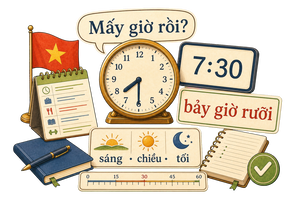
To tell time in Vietnamese, say the hour followed by giờ, then add the minutes. Two o'clock is hai giờ, 2:10 is hai giờ mười, and 2:30 is hai giờ rưỡi. Ask "What time is it?" with Mấy giờ rồi?
| English | Vietnamese |
|---|---|
| What time is it? | Mấy giờ rồi? |
| Two o'clock | Hai giờ |
| 2:10 | Hai giờ mười |
| 2:30 | Hai giờ rưỡi |
| 7:00 AM | Bảy giờ sáng |
If the number words are not familiar yet, review the Vietnamese numbers guide first.
How to Ask "What Time Is It?"
There are two common ways to ask for the time in Vietnamese. Both are understood everywhere and you can use either one in any situation.
Casual
Mấy giờ rồi?
Literally means "how many hours already?", this is the most common way to ask for the time in everyday speech.
More formal
Bây giờ là mấy giờ?
Literally means "now is how many hours?", it is slightly more formal, but also common in daily conversation.
A typical exchange looks like this:
A: Mấy giờ rồi? — What time is it?
B: Bây giờ là hai giờ. — It's two o'clock now.
To answer, use bây giờ là, followed by the time. You can also just state the time directly. Both are natural.

Preply
A website for finding and booking live 1-on-1 Vietnamese tutors by price, availability, specialty, and accent, with paid trial lessons.
Telling the Hour
The word giờ means both "hour" and "o'clock". To say the time on the hour, place a number in front of giờ. The formula is simple: number + giờ. If you can count to twelve in Vietnamese, you already know how to say every hour.
| Time | Vietnamese | Meaning |
|---|---|---|
| 1:00 | một giờ | one hour |
| 2:00 | hai giờ | two hour |
| 3:00 | ba giờ | three hour |
| 4:00 | bốn giờ | four hour |
| 5:00 | năm giờ | five hour |
| 6:00 | sáu giờ | six hour |
| 7:00 | bảy giờ | seven hour |
| 8:00 | tám giờ | eight hour |
| 9:00 | chín giờ | nine hour |
| 10:00 | mười giờ | ten hour |
| 11:00 | mười một giờ | ten-one hour |
| 12:00 | mười hai giờ | ten-two hour |
Half Past, Quarter Past, and Minutes
Vietnamese uses four patterns to express minutes. Once you know giờ (hour), rưỡi (half), phút (minute), and kém (minus), you can say any time.
Half past with rưỡi
Add rưỡi after the hour to mean "half past". This works for every hour.
| Time | Vietnamese | Meaning |
|---|---|---|
| 2:30 | hai giờ rưỡi | two hour half |
| 7:30 | bảy giờ rưỡi | seven hour half |
| 11:30 | mười một giờ rưỡi | eleven hour half |
Minutes past the hour
For exact minutes, put the minute number after giờ. The word phút means "minute". It can be added for clarity but is usually dropped in casual speech.
Formula: number + giờ + minutes. Optionally add phút at the end.
| Time | Vietnamese | Meaning |
|---|---|---|
| 3:05 | ba giờ năm | three hour five |
| 3:15 | ba giờ mười lăm | three hour fifteen |
| 5:20 | năm giờ hai mươi | five hour twenty |
| 9:45 | chín giờ bốn mươi lăm | nine hour forty-five |
Minutes to the next hour with kém
Use kém to express minutes before the next hour. It means "less" or "minus". Name the upcoming hour, then add kém and the number of minutes remaining.
Formula: next hour + giờ + kém + minutes
| Time | Vietnamese | Meaning |
|---|---|---|
| 6:50 | bảy giờ kém mười | seven hour minus ten |
| 6:45 | bảy giờ kém mười lăm | seven hour minus fifteen |
| 11:55 | mười hai giờ kém năm | twelve hour minus five |
The năm / lăm rule
The number 5 on its own is năm. But when a number ends in 5, that final 5 becomes lăm. Think of it this way: if 5 comes after another digit, say lăm. This is a general Vietnamese number rule, not specific to time.
| Number | Vietnamese | Why |
|---|---|---|
| 5 | năm | 5 by itself → năm |
| 15 | mười lăm | ends in 5 → lăm |
| 25 | hai mươi lăm | ends in 5 → lăm |
| 35 | ba mươi lăm | ends in 5 → lăm |
| 50 | năm mươi | 5 at the start → năm |
Similarly, mười becomes mươi in compound tens: hai mươi, ba mươi, and so on. Mười is the standalone number 10. Mươi is used when it follows another digit like 20 or 30.
Parts of the Day
Vietnamese does not use AM and PM. Instead, speakers add a time-of-day word after the hour to specify which part of the day they mean. These five markers cover the full 24-hour cycle.
| Vietnamese | Meaning | Approximate hours | Example |
|---|---|---|---|
| sáng | morning | 5:00 – 11:00 | tám giờ sáng = 8 AM |
| trưa | noon, midday | 11:00 – 13:00 | mười hai giờ trưa = 12 noon |
| chiều | afternoon | 13:00 – 18:00 | hai giờ chiều = 2 PM |
| tối | evening | 18:00 – 22:00 | bảy giờ tối = 7 PM |
| đêm | night, late night | 22:00 – 5:00 | hai giờ đêm = 2 AM |
The markers are placed after the full time expression: ba giờ rưỡi chiều = 3:30 PM. When the context is already clear, speakers often omit the marker.
Sáng vs. buổi sáng
When telling time, use the short form: tám giờ sáng. The longer form buổi sáng means "the morning" as a general period. It is used in phrases like buổi sáng nay, meaning "this morning", not directly with clock time.
Overlap hours
The boundaries between markers are flexible, not rigid. At 11:30 you might hear either mười một giờ rưỡi sáng or mười một giờ rưỡi trưa. Context and personal habit will guide which one sounds more natural.
12-Hour vs. 24-Hour Clock
Vietnamese speakers switch between the two formats depending on the situation. In everyday speech, the 12-hour clock with time-of-day markers is standard. Written schedules and formal contexts tend to use the 24-hour clock.
| Context | 12-hour format | 24-hour format |
|---|---|---|
| Casual conversation | bảy giờ tối = 7 PM | mười chín giờ = 19:00 |
| Bus or train schedule | sáu giờ sáng = 6 AM | sáu giờ = 06:00 |
| Business meeting | hai giờ chiều = 2 PM | mười bốn giờ = 14:00 |
| Flight departure | chín giờ tối = 9 PM | hai mươi mốt giờ = 21:00 |
For the 24-hour clock, simply continue counting past twelve: mười ba giờ for 13:00, mười bốn giờ for 14:00, up to hai mươi ba giờ for 23:00. An advantage of the 24-hour format is that there is no confusion about AM or PM.
Talking About Duration
When talking about how long something takes rather than what time it happens, Vietnamese uses different words. This distinction is important. Do not confuse clock time with duration.
| Unit | Clock time | Duration | Example |
|---|---|---|---|
| hour | giờ | tiếng | hai tiếng = two hours |
| minute | phút | phút | mười phút = ten minutes |
| second | — | giây | ba mươi giây = thirty seconds |
Giờ vs. tiếng
Both giờ and tiếng can mean "hour" for duration, but tiếng is the more common and clear choice. Using tiếng avoids any ambiguity with clock time. hai giờ could mean either "2 o'clock" or "2 hours". hai tiếng always means "2 hours".
Half an hour
"Half an hour" is nửa tiếng. "An hour and a half" is một tiếng rưỡi. These are common in everyday conversation for appointments, travel time, and cooking.
Useful Time Phrases
Beyond reading the clock, these phrases help you schedule plans, ask about timing, and navigate daily life in Vietnam.
Scheduling and plans
| Vietnamese | English | When to use |
|---|---|---|
| Mấy giờ gặp? | What time do we meet? | Arranging meetups with friends or colleagues |
| Hẹn gặp lúc... | See you at... | Confirming a time: Hẹn gặp lúc bảy giờ |
| Mấy giờ mở cửa? | What time does it open? | Shops, restaurants, attractions |
| Mấy giờ đóng cửa? | What time does it close? | Shops, restaurants, attractions |
| Mấy giờ bắt đầu? | What time does it start? | Events, classes, movies |
| Mấy giờ kết thúc? | What time does it end? | Events, classes, work |
Punctuality and timing
| Vietnamese | English |
|---|---|
| đúng giờ | on time, punctual |
| sớm | early |
| trễ / muộn | late |
| khoảng | approximately, around |
| lúc | at a specific time |
| từ... đến... | from... to... |
Example conversations
Making plans
A: Mấy giờ gặp? — What time do we meet?
B: Khoảng bảy giờ tối. — Around 7 PM.
A: OK, hẹn gặp lúc bảy giờ! — OK, see you at 7!
At a shop
A: Mấy giờ đóng cửa? — What time do you close?
B: Chín giờ tối. — 9 PM.
A: Cảm ơn! — Thank you!
Running late
A: Bạn ở đâu rồi? — Where are you?
B: Xin lỗi, tôi trễ khoảng mười phút. — Sorry, I'm about 10 minutes late.
A: Không sao! — No problem!
Asking about duration
A: Đi mất bao lâu? — How long does it take to get there?
B: Khoảng một tiếng rưỡi. — About an hour and a half.
A: Xa quá! — That's far!
Quick Reference Table
A cheat sheet covering the most important time expressions. Bookmark this page and come back whenever you need a quick refresher.
| English | Vietnamese |
|---|---|
| 1:00 | một giờ |
| 2:00 | hai giờ |
| 3:00 | ba giờ |
| 4:00 | bốn giờ |
| 5:00 | năm giờ |
| 6:00 | sáu giờ |
| 7:00 | bảy giờ |
| 8:00 | tám giờ |
| 9:00 | chín giờ |
| 10:00 | mười giờ |
| 11:00 | mười một giờ |
| 12:00 | mười hai giờ |
| 1:05 | một giờ năm phút |
| 2:10 | hai giờ mười phút |
| 3:15 | ba giờ mười lăm |
| 4:20 | bốn giờ hai mươi |
| 5:25 | năm giờ hai mươi lăm |
| 6:30 | sáu giờ rưỡi |
| 6:35 | sáu giờ ba mươi lăm |
| 6:40 | bảy giờ kém hai mươi |
| 6:45 | bảy giờ kém mười lăm |
| 6:50 | bảy giờ kém mười |
| 6:55 | bảy giờ kém năm |
| 8 AM | tám giờ sáng |
| 12 noon | mười hai giờ trưa |
| 2 PM | hai giờ chiều |
| 7 PM | bảy giờ tối |
| 12 midnight | mười hai giờ đêm |
| Duration | |
| 2 hours | hai tiếng |
| 30 minutes | ba mươi phút, nửa tiếng |
| 1.5 hours | một tiếng rưỡi |
| Common questions | |
| What time is it? | Mấy giờ rồi? |
| What time do we meet? | Mấy giờ gặp? |
| What time does it open? | Mấy giờ mở cửa? |
| How long does it take? | Mất bao lâu? |
FAQ
Looking for Resources?
Explore our hand-picked learning resources. Filter by dialect, skills and more to find the best resources for your learning goals.